The more we get kids to talk about the things that are important to them, the more we are helping the - intellectually and in self-confidence. One way to get kids talking is to simply rephrase your question from "closed" to "open". It's simple, and takes no time at all. With just a quick change to the type of question we pose, we're telling our kids that we are really interested in what they have to say.
For instance, if you want your child to tell you about his day at school, a closed question would be something like, "Did you have a good day at school?" or "It looks like you had a great day, right?" Those are "closed" because the child can answer the question with a simple, "Yes" or "No", and go right back to watching TV. "Do you feel like this book is hard or easy?" is another closed question because the child can answer the question with one word -- "hard", or "easy".
"Open" versions of the first questions are, "Tell me about your day today in school?" or "What are 3 things that happened today that were good or bad." The "open" questions are going to elicit much more detail, time and thought from your child.
An "open" version of the second question might be, "What is this book about?" or "What is your (least) favorite part of this book?"
Get kids talking to get kids thinking!
Showing posts with label children's book. Show all posts
Thursday, April 26, 2012
Wednesday, November 9, 2011
Book Report: Baby Max and Ruby - Birthday
Wednesday, August 10, 2011
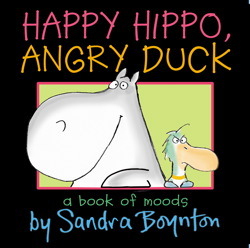
Book Report: Happy Hippo, Angry Duck by Sandra Boynton
Wednesday, August 3, 2011
No Muss, No Fuss, No Clean-Up: Fun Geometry and Communication Activity
Looking for another easy, low-cost, no clean-up activity? How about one that improves kids' communication AND geometry skills? Check this out! Have your child draw a simple picture like the one shown here. It requires little artistic ability from the child, which means there shouldn't be any stress involved.
When she's finished drawing, DON'T LOOK at the image. Instead, get your own sheet of blank paper and sit with your back facing her. Her job is to describe to you her drawing in enough detail and geometric and positional language that you can draw your own version of her original image.
For instance, she might start out by saying, "Draw a circle". Well, without having seen the original, you may pick up the pink marker and draw a huge circle that takes up the entire page. What she'll soon see is that she needs to say something like, "Draw a small gray circle with a black circumference." Then she has to convey to you that there is a purplish-blue triangle hanging from the bottom left side of the circle. But, she'll have to let you know that it is an equilateral triangle, as opposed to a bottom-pointing isosceles triangle or something else. She also have to let you know that the triangle is similarly sized to the circle. Next, she'll have to use her language to get you to draw the kite/diamond and the floating orange pentagon.
You can make up your own rules, such as the listening artist is allowed 5 clarifying questions, or the original artist is allowed to peak at the listening artist's work as it's being drawn so she can be more exact with her descriptions.
The possibilities are absolutely endless, and there's no reason multiple kids couldn't participate in this, if you're needing a little break. One child could still be the original artist and a whole group of kids could be the listening artists. Have fun! And, as always, happy learning!
Sunday, July 31, 2011
Never-ending Endings
Kids of all ages love hearing stories. They also love making up their own stories. Tonight, for a quick and easy change of pace, read just half a book/story to your child and challenge him to come up with his own ending for the story. It doesn't matter if it's a new book that you've never read, or an old favorite, your child will (most likely) love coming up with his own sequence of events. More than just fun, this piques children's imagination and keeps them excited about reading. There are literally endless possibilities, and you can take turns coming up with alternate endings. Your child will love hearing what kooky new twist you come up with and will no doubt have critiques on how it could be better. Instead of the Brown Bear seeing the Red Bird, let your 4 year old throw in a pink polk-a-dotted parakeet. Instead of the Three Little Bears scaring Goldilocks when she wakes up, have them invite her to stay for more porridge, fall in love with Baby Bear's neighbor friend who stops by to play and live happily ever after. Whatever you do, make reading an adventure. Make it fun and once your child sees how much fun you're having, he's sure to jump right in!
Labels:
book endings,
children's book,
fun,
idea,
literacy,
read,
young kids
Thursday, June 30, 2011
Book Report: Textured Soft Shapes: High Tide by iKids and Kate Davis
A puzzle? Bath toy? Book? Which is it? All 3 and then some! This simple book consisting of just 5 pages packs in a bunch of learning skills. Rhyming riddles describe different sea creatures whose identities are revealed when kids remove their outlines from the following page. I see kids loving this because of the rhymes, bright colors, soft animal cutouts. I see parents loving this because it is waterproof, tear proof and floats. Let your kiddos read in the bathtub, at the beach or in their beds and never worry about the integrity of this book. Great for kids 6 months-2+. We found it on Amazon for just $10.39.
Tuesday, June 21, 2011
Book Report: Ten Friendly Fish by Debbie Tarbett
My little monster is just 19 months, but she has more fun with colorful, counting book than I'd ever imagine. Ten Friendly Fish is full of vivid pictures of sea life that she just adores. In fact, her limited vocabulary includes "oppa" (octopus), which I'm certain is a direct result of this book. With each turn of the page, one more fish gets distracted by a new sea friend until the very end when the one lone fish is once again reunited with all of his original buddies at their party in the sea! Great for learning sea life names, looking at brilliant pictures and of course, counting! Tarbett also has a similar book about Ten, Wriggly, Wiggly Caterpillars, if that's more your style! We found Ten Friendly Fish on Amazon for $18.95.
Subscribe to:
Posts (Atom)