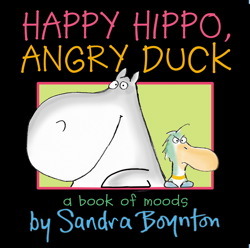
 Who doesn't love Sandra Boynton's books? They're funny, cute, kid-appealing, and this one in particular has a really important talking point for kids. Happy Hippo, Angry Duck takes a light-hearted approach to kids' feelings and letting them know that being sad, angry, happy or frazzled is totally and completely normal. As always, Boynton's illustrations attract kids, but it's the message in the book that I find so compelling. I think so often we forget that kids need to know that being confused or angry is just part of life. She ends on such a positive note by saying ". . .I hope you are happy. But if you are not, you have friends who will help you." We need to emphasize to even the youngest kids that they are surrounded by family and friends who love and support them no matter what. Two thumbs up for this multi-purpose book! We found it on Amazon for just $5.99!
Wednesday, August 10, 2011
Book Report: Happy Hippo, Angry Duck by Sandra Boynton
Who doesn't love Sandra Boynton's books? They're funny, cute, kid-appealing, and this one in particular has a really important talking point for kids. Happy Hippo, Angry Duck takes a light-hearted approach to kids' feelings and letting them know that being sad, angry, happy or frazzled is totally and completely normal. As always, Boynton's illustrations attract kids, but it's the message in the book that I find so compelling. I think so often we forget that kids need to know that being confused or angry is just part of life. She ends on such a positive note by saying ". . .I hope you are happy. But if you are not, you have friends who will help you." We need to emphasize to even the youngest kids that they are surrounded by family and friends who love and support them no matter what. Two thumbs up for this multi-purpose book! We found it on Amazon for just $5.99! 

Saturday, August 6, 2011
Let's Explore this Further (or is it Farther?)
Here's another one of those pesky word pairs that tends to get mixed up by a lot of well-meaning folks. When do you use "further" and when is "farther" the correct word to use? (And, no, it's never "Happy Farther's Day")
 |
| This jockey is riding farther (and faster) than anticipated! |
So it's pretty easy, actually. "Farther" is correct when you are talking about an physical, measurable distance (as in, Her car is parked farther away than mine).
"Further" should be used when you are talking about additional time, quantities or degrees (as in, We need to discuss this word pair further to be totally clear on it).
I keep the two straight by using the "far" in farther to remind me that that one relates to distance. We ran farther than she did. The sun is farther from the Earth than is the moon.
Have any further comments or questions, please share them below!
Wednesday, August 3, 2011
No Muss, No Fuss, No Clean-Up: Fun Geometry and Communication Activity
Looking for another easy, low-cost, no clean-up activity? How about one that improves kids' communication AND geometry skills? Check this out! Have your child draw a simple picture like the one shown here. It requires little artistic ability from the child, which means there shouldn't be any stress involved.
 When she's finished drawing, DON'T LOOK at the image. Instead, get your own sheet of blank paper and sit with your back facing her. Her job is to describe to you her drawing in enough detail and geometric and positional language that you can draw your own version of her original image.
For instance, she might start out by saying, "Draw a circle". Well, without having seen the original, you may pick up the pink marker and draw a huge circle that takes up the entire page. What she'll soon see is that she needs to say something like, "Draw a small gray circle with a black circumference." Then she has to convey to you that there is a purplish-blue triangle hanging from the bottom left side of the circle. But, she'll have to let you know that it is an equilateral triangle, as opposed to a bottom-pointing isosceles triangle or something else. She also have to let you know that the triangle is similarly sized to the circle. Next, she'll have to use her language to get you to draw the kite/diamond and the floating orange pentagon.
You can make up your own rules, such as the listening artist is allowed 5 clarifying questions, or the original artist is allowed to peak at the listening artist's work as it's being drawn so she can be more exact with her descriptions.
The possibilities are absolutely endless, and there's no reason multiple kids couldn't participate in this, if you're needing a little break. One child could still be the original artist and a whole group of kids could be the listening artists. Have fun! And, as always, happy learning!
For instance, she might start out by saying, "Draw a circle". Well, without having seen the original, you may pick up the pink marker and draw a huge circle that takes up the entire page. What she'll soon see is that she needs to say something like, "Draw a small gray circle with a black circumference." Then she has to convey to you that there is a purplish-blue triangle hanging from the bottom left side of the circle. But, she'll have to let you know that it is an equilateral triangle, as opposed to a bottom-pointing isosceles triangle or something else. She also have to let you know that the triangle is similarly sized to the circle. Next, she'll have to use her language to get you to draw the kite/diamond and the floating orange pentagon.
You can make up your own rules, such as the listening artist is allowed 5 clarifying questions, or the original artist is allowed to peak at the listening artist's work as it's being drawn so she can be more exact with her descriptions.
The possibilities are absolutely endless, and there's no reason multiple kids couldn't participate in this, if you're needing a little break. One child could still be the original artist and a whole group of kids could be the listening artists. Have fun! And, as always, happy learning!
Sunday, July 31, 2011
Never-ending Endings

Monday, July 18, 2011
Statue of Sanity
Kids driving you a little nuts already this summer? Maybe the idea of a road trip send shivers down your spine because your angels mysteriously turn into something else about 2 blocks from your house? Here's a no-materials, no-mess game that I used to have my students play while they waited in line. It's in a similar vein to "The Silent Game" except the kids are supposed to be as still as statues. That's it. You, or one of your kids is designated "Statue Master" and gives the rest of the crew a 5-4-3-2-1 countdown (during which time the "statues" get all of their wiggles out). Once they hear "1", though, they have to freeze and be perfectly still. The Statue Master observes and eliminates anybody who moves. Simple? Yes. A great way to get your kids to stop fighting or calm down or do whatever it is you need them to do? Yes! Enjoy, fellow Statue Masters!
![]()

Friday, July 15, 2011
Turn the Sunshine into a Science Lesson
It is so hot. It's hot in the sun, it's even hot in the shade. We hear repeatedly that we need to help our little Ones stay cool by dressing them wisely in light-colored clothing, but why not let them explore the "why" behind that idea? In other words, turn the daily clothing battle into a learning experience that's meaningful to them.
![]() Here's what you can do. Have your kiddos grab one black (or dark) sock and one white sock. Ask them to make a hypothesis (prediction) about which sock will be hotter, when left in the sun. (And, yes, use the word, "hypothesis" -- they can handle it). Ask them why they predicted what they did. Put the socks side-by-side in the sun and place a thermometer inside each one (use outdoor thermometer or regular household thermometers). Have your child check the temperatures of the socks periodically (they may need help reading the thermometer, so keep that in mind as another valuable life lesson). They should see that the dark sock is significantly hotter than the light/white sock. Now ask them if they'd rather wear light-colored clothing on a hot day or dark clothes. With any luck, the experiment's results will transfer and they'll realize that white is much better.
Here's what you can do. Have your kiddos grab one black (or dark) sock and one white sock. Ask them to make a hypothesis (prediction) about which sock will be hotter, when left in the sun. (And, yes, use the word, "hypothesis" -- they can handle it). Ask them why they predicted what they did. Put the socks side-by-side in the sun and place a thermometer inside each one (use outdoor thermometer or regular household thermometers). Have your child check the temperatures of the socks periodically (they may need help reading the thermometer, so keep that in mind as another valuable life lesson). They should see that the dark sock is significantly hotter than the light/white sock. Now ask them if they'd rather wear light-colored clothing on a hot day or dark clothes. With any luck, the experiment's results will transfer and they'll realize that white is much better.
![]()
In a nutshell, the reason for this is that dark colored clothes ABSORB light/heat which make the person even warmer. Light/white clothes REFLECT light/heat and therefore keep a person feeling relatively cooler.
Now, see if your child really gets it by asking him which color clothing he should wear outside in the winter!


In a nutshell, the reason for this is that dark colored clothes ABSORB light/heat which make the person even warmer. Light/white clothes REFLECT light/heat and therefore keep a person feeling relatively cooler.
Now, see if your child really gets it by asking him which color clothing he should wear outside in the winter!
Thursday, July 14, 2011
Bubble Geometry

The object, of course, is to blow the biggest bubble. Let your kids experiment with different shaped bubble-makers (homemade or store bought). They can use wire coat hangers, string, or the wands that come with the bubble solution. Here's the math part. Once the bubbles pop, use the bubble ring that's left on the sidewalk and have a quick talk with your kids about the diameter, radius and circumference. (See the definitions below for your refresher course.) Get the rulers out and have your kids measure each of the three for each bubble they blow. Have them make their own data sheets to keep the records straight.
If you have multiple kids, you can make it a competition or have them work together in a team effort (which life lesson will you choose today?); if you have one child, see if he can "beat" his record with each successive bubble. What improvements can your kids add to increase the size of their bubbles?
Your kids' math teachers will love you and your kids will be having so much fun, they'll do all the math you want just to keep making the biggest bubble! It's most definitely a win-win!
DIAMETER: any straight line segment that passes through the center of the circle and whose endpoints are on the circle (remember, the line segment has to start and end on the circle AND PASS THROUGH THE CENTER POINT)
RADIUS: any line segment from its center or axis of symmetry to its perimeter (think of this like a spoke on a wheel; the line segment has to have one end point on the center of the circle and one endpoint on the circle itself)
CIRCUMFERENCE: the perimeter (or distance) around the circle; you calculate this by (C=πd) OR (C=2*π*r) (π = 3.1415)

- have your kids measure in centimeters and inches
- have your kids find the difference between each bubble's measurements
- have your kids research WHY bubbles are always spherical no matter what shape the wand is
Happy blowing!
Subscribe to:
Posts (Atom)